
Alectra & Enbridge Winter Heating Costs in Mississauga: What You’ll Actually Pay
Mississauga homes split into two heating-cost worlds — gas-heated (Enbridge) and electric-heated (Alectra) — and the gap between them widens sharply every November. Here’s the real math for both, using current OEB- and Enbridge-approved rates.
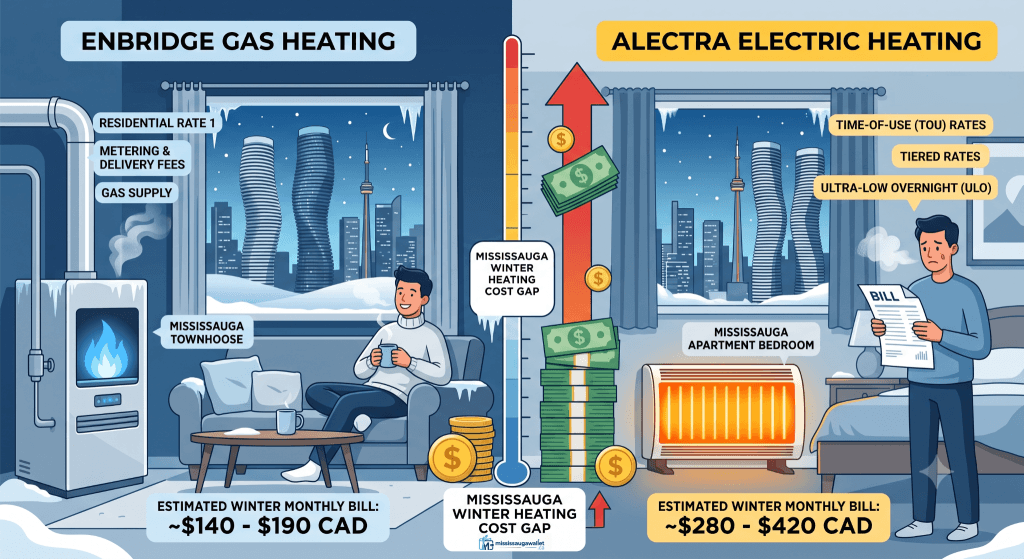
Mississauga’s Two Heating Systems — and Why It Matters
Most Mississauga homes — particularly detached and townhouse stock across Churchill Meadows, Streetsville, Clarkson, and Malton — run forced-air natural gas furnaces billed through Enbridge Gas. A meaningful share of older apartment and condo stock, especially pre-1990s rental buildings in City Centre and Cooksville, runs electric baseboard heat billed entirely through Alectra Utilities. These two systems don’t just use different fuel — they’re billed on completely different rate structures, and the financial gap between them is largest from December through February.
Why this matters for renters specifically: if you’re comparing two units at similar rent, ask which heating system each one uses before you sign. A gas-heated apartment and an electric-baseboard apartment of the same size can differ by $150–$250 in a single winter month, even before rent.
Enbridge Gas Rates: What’s Actually on Your Bill
If your home is gas-heated, you’re billed under Enbridge’s Rate 1 (residential), which the Ontario Energy Board reviews and adjusts quarterly. As of the rate notice effective October 1, 2026, here’s what’s on the bill, component by component:
| Bill Component | Current Rate | Notes |
|---|---|---|
| Customer (fixed monthly) charge | $27.69/month | Flat fee regardless of usage |
| Delivery, first 30 m³ | 14.2691 ¢/m³ | Declining block rate |
| Delivery, next 55 m³ | 13.4308 ¢/m³ | |
| Delivery, next 85 m³ | 12.7744 ¢/m³ | |
| Delivery, over 170 m³ | 12.2850 ¢/m³ | Most winter usage lands here |
| Transportation to Enbridge | 5.4818 ¢/m³ | Pipeline cost, passed through at no markup |
| Total effective gas supply rate | 9.1080 ¢/m³ | 9.4741 ¢ commodity charge less a 0.3661 ¢ cost adjustment |
| Cost adjustment, transportation and delivery | 0.8983 ¢/m³ | 0.3634 ¢ transportation plus 0.5349 ¢ delivery |
Source: Ontario Energy Board, October 1, 2026 Natural Gas Rate Changes, Enbridge Gas Distribution (EGD) rate zone, residential rates.
These rates change quarterly. Enbridge and the OEB review and adjust gas supply pricing every three months (January, April, July, October). The figures above reflect the most recently published rate notice. By the time peak winter billing hits in January, expect a new quarterly adjustment — confirm the current rate at enbridgegas.com/rates before budgeting precisely.
The practical takeaway: delivery charges drop per cubic metre the more you use, which is the opposite of how electricity tiers work. A high-usage winter month doesn’t push you into a more expensive bracket on the gas side — it’s actually the reverse, which is some small relief during the coldest stretch.
What changed on October 1, 2026: the gas supply rate rose from the spring notice, while delivery and transportation both fell. The OEB puts the net effect at $4.27 less per year for a typical home using 2,400 m³. A separate one-time rate adjustment of 0.6494 ¢/m³ in the customer’s favour is worth another $15.59, for a total annual change of $19.86 less. That credit is temporary and is not in the table above.
Alectra Electricity Rates for Electric Heat
If your unit relies on electric baseboard heating, your winter bill is driven entirely by which Ontario Energy Board rate plan you’re on. Alectra passes these rates through with no markup. Three plans are available, and the gap between them is enormous in winter:
| Plan | Period | Rate (¢/kWh) |
|---|---|---|
| Time-of-Use (TOU) | Off-peak (weekdays 7pm–7am, all weekend) | 9.8 |
| Time-of-Use (TOU) | Mid-peak (weekdays 11am–5pm) | 15.7 |
| Time-of-Use (TOU) | On-peak (weekdays 7–11am, 5–7pm) | 20.3 |
| Tiered | Tier 1 — first 1,000 kWh/month (winter threshold) | 12.0 |
| Tiered | Tier 2 — above 1,000 kWh/month | 14.2 |
| Ultra-Low Overnight (ULO) | Ultra-low overnight (every day, 11pm–7am) | 3.9 |
| Ultra-Low Overnight (ULO) | Weekend off-peak | 9.8 |
| Ultra-Low Overnight (ULO) | Mid-peak (weekdays 7am–4pm, 9–11pm) | 15.7 |
| Ultra-Low Overnight (ULO) | On-peak (weekdays 4–9pm) | 39.1 |
Source: Ontario Energy Board, Regulated Price Plan rates effective November 1, 2025 (winter time periods shown).
The winter trap with electric baseboard heat: baseboard heaters run hardest exactly when you’re home and the thermostat is fighting outdoor cold — which is also when on-peak and mid-peak windows hit. Unlike a furnace that cycles briefly, baseboards draw continuously for hours, so timing matters far more than with gas.
Sample Winter Bills by Home Type
These are illustrative calculations using the rates above, not guarantees — actual bills depend on insulation, thermostat settings, square footage, and weather. They’re meant to show the order of magnitude, not predict your exact bill.
The gas-heated estimate assumes roughly 280–320 m³ consumed in a peak winter month for a typical townhouse — well into the lowest delivery block — plus the fixed customer charge. The electric estimates assume a one-bedroom to small two-bedroom unit running baseboard heat for several hours daily through the coldest stretch of the season, with consumption landing well above the 1,000 kWh Tier 1 threshold on the Tiered plan.
The pattern holds even though every number above is an estimate: gas heating is structurally cheaper per unit of warmth in Mississauga’s current rate environment, and the spread between gas and electric baseboard heat is at its widest in January and February.
Which Alectra Rate Plan Wins in Winter?
If you’re on electric heat and have a choice of plan, the right answer depends entirely on when your baseboards are actually running:
| Your situation | Best plan | Why |
|---|---|---|
| Home all day, heat runs continuously | Tiered | Flat rate avoids ULO’s brutal 39.1¢ peak window |
| Out during the day, heat mostly evenings/overnight | TOU | Off-peak (9.8¢) covers most overnight heating hours |
| Can program a smart thermostat to pre-heat overnight | ULO | 3.9¢ overnight rate rewards pre-heating before the 4–9pm spike |
| Unsure / inconsistent schedule | Tiered | Simplest, no timing risk |
ULO is a bet, not a default. If you can’t realistically shift the bulk of your heating load to overnight hours, ULO’s 39.1¢/kWh weekday on-peak rate (4–9pm — exactly when most people get home and crank the heat) can push your bill higher, not lower, than Tiered or TOU. Only switch if you can genuinely pre-heat overnight or use a programmable thermostat aggressively.
You can switch plans by contacting Alectra directly — there’s no fee, and no obligation to stay on a plan once selected. Changes typically take effect within one billing cycle.
Five Ways to Lower Your Winter Bill
- Check your heating system before signing a lease, not after. If a Mississauga rental listing doesn’t specify the heating type, ask directly — “gas-heated” vs. “electric baseboard” is one of the single biggest hidden cost variables in winter rent comparisons.
- Confirm your Alectra rate plan matches your actual schedule. Most households default to TOU without ever comparing it to Tiered. If your routine doesn’t match TOU’s off-peak window, the default plan may be quietly costing you more.
- For gas-heated homes, a programmable thermostat still helps. Even though gas delivery rates decline with higher usage, a 1–2°C nighttime setback on a furnace meaningfully reduces total m³ consumed over a billing cycle.
- Watch for the facility carbon charge and transportation charge creeping upward. These are smaller line items, but they move every quarter — check your actual bill against the current published rate notice rather than assuming last quarter’s numbers still apply.
- If electric baseboard heat is unavoidable, weatherstrip aggressively. Baseboard systems have no ductwork to lose heat through, but older Mississauga rental stock with electric heat often has the oldest windows and weakest insulation in the city’s housing mix — sealing drafts has an outsized effect here specifically.
Bill Assistance Programs
Both utilities participate in OEB-overseen assistance programs for households that qualify:
- Ontario Electricity Support Program (OESP): a monthly credit applied directly to Alectra bills for income-qualifying households.
- Low-income Energy Assistance Program (LEAP): emergency funds for both gas and electricity customers facing disconnection, administered through local agencies.
- OEB winter disconnection ban: electricity distributors cannot disconnect residential customers for non-payment between November 15 and April 30, regardless of rate plan.
Applications for both programs go through the OEB’s consumer protection office or directly through Alectra and Enbridge customer service — neither utility can require proof beyond standard income documentation.