
Neighbourhood Guide · Port Credit
Port Credit: Mississauga's Lakefront Address, Now at a Below-Average Price
Port Credit's rent used to command a premium over most of Mississauga. A sharp 2026 correction changed that, and it now rents below the city average. We track exactly what living here costs today, and whether the waterfront lifestyle is worth it at your income, commute, and lease.
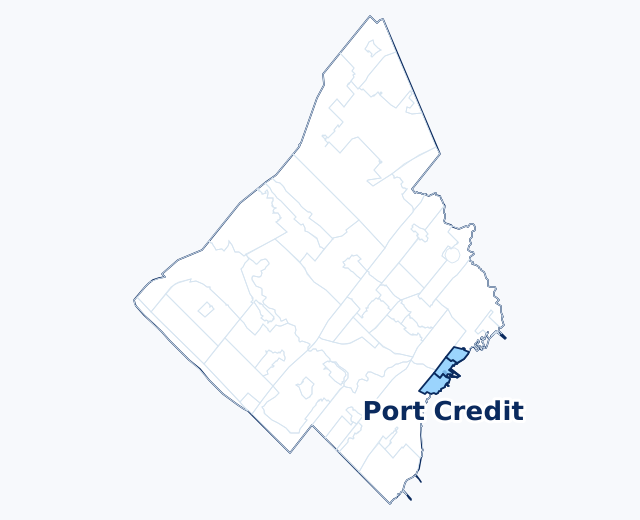
Port Credit sits at the mouth of the Credit River on Lake Ontario — Mississauga's oldest town, absorbed into the city in 1974 and, until recently, the neighbourhood that commanded some of the region's highest residential rents. A sharp correction through 2026 has changed that math: Port Credit's rent now sits below the city average. The waterfront lifestyle is unchanged either way: a walkable village core, direct GO Lakeshore West service to Union Station in 28 minutes, a farmers market, jazz festival, and a concentration of independent restaurants you won't find in the city's interior.
This hub tracks every financial dimension of living or operating a business in Port Credit — from how it now compares against Clarkson or Lorne Park, to the property tax rate on L5G and L5H homes, the actual cost of the GO commute, and what Alectra electricity rates look like in the neighbourhood's older housing stock. Every figure comes from primary sources: CMHC, MPAC, Metrolinx fare tables, and OEB-regulated utility rates.
If you're deciding whether Port Credit is worth it financially, the articles and calculators below give you the exact numbers to make that call — not generic Ontario averages.
What shapes the cost of living in Port Credit
- Postal codes L5G and L5H — highest rent density in Ward 1; waterfront-facing units can exceed $6,500/month
- GO Lakeshore West: Port Credit Station to Union Station ~28 min; PRESTO single fare ~$6–9; monthly pass ~$224 — see the full GO Transit cost guide for parking and concession details
- Port Credit GO is the planned southern terminus of the Hazel McCallion LRT — under construction, earliest opening 2028
- Ontario's One Fare program: MiWay-to-GO transfers at no extra cost within a 2-hour window — full details here
- Electricity provider: Alectra Utilities — TOU, Tiered, and ULO rate plans available; older Port Credit buildings run higher heating loads
- Natural gas: Enbridge Gas — older housing stock dominant; higher seasonal usage than newer Mississauga builds
- Water & sewer: billed by Peel Region quarterly — often included in older apartment rents, rarely in new condos
- Rent control applies to units first occupied before Nov 15, 2018 — many Port Credit buildings qualify; ask before signing
- MPAC assessments currently based on Jan 1, 2016 values — see the Property Tax Estimator for your address
- Car insurance: same Mississauga rate zone as Clarkson and Cooksville — roughly $2,531–$3,078/year at mid-range coverage
- Home business zoning: residential permitted uses apply — no retail foot-traffic clients; full framework here
Correction · Corrected 14 September 2026. This page previously gave Port Credit’s 1-bedroom and 2-bedroom rents as estimates of $1,884 and $2,158, scaled from an older unit-type split, and its all-unit rent as $2,129. Every figure now comes from Zumper’s 14 September 2026 reading: $1,998 for a 1-bedroom, $2,350 for a 2-bedroom and $2,032 across all units. The answer on affording Port Credit at $65,000 was rebuilt on the 1-bedroom median: rent takes about 37% of that income, not 35%, and about $69 a month is left in the sample budget.