
Alectra Rate Plans:
TOU vs. Tiered vs. Ultra-Low Overnight — Which One Actually Saves You Money?
Alectra gives Mississauga households three ways to pay for electricity. Choosing the wrong one can cost you $150–$300 a year without knowing it. Here's the full breakdown, with actual 2026 OEB rates and dollar-by-dollar comparisons.
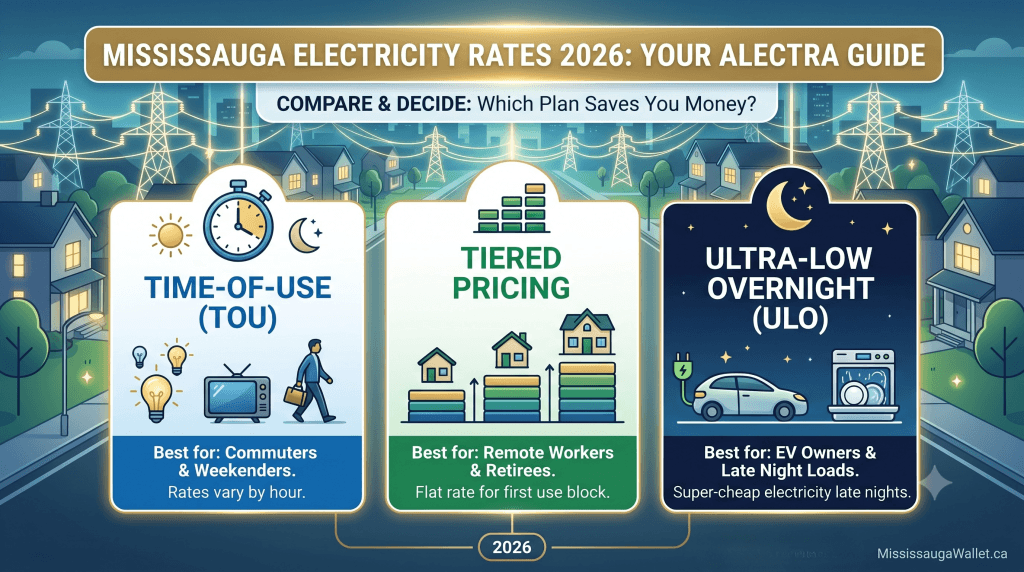
Most Mississauga households are on Time-of-Use by default and never switch. If you're home most of the day (remote worker, shift worker on afternoons, family with young kids), Tiered pricing is almost certainly cheaper this summer. If you own an EV or run a dishwasher overnight, Ultra-Low Overnight can cut your electricity cost nearly in half on those loads. There is no penalty to switch, and you can change your plan any time through My Alectra.
Want to know which period you are in right now, and what it changes to next? The rate checker reads the Toronto clock and handles the seasonal hours, weekends and statutory holidays for you.
The Three Plans, Explained Plainly
Every Mississauga residential or small business customer served by Alectra Utilities is on the Regulated Price Plan (RPP) — a provincial pricing framework set by the Ontario Energy Board. Within the RPP, you can choose between three billing structures. Alectra passes the electricity commodity cost through to you at exactly the OEB rate, without markup. What changes between plans is how that cost is calculated.
Time-of-Use (TOU) charges different rates depending on when during the day you consume electricity. There are three price tiers — on-peak, mid-peak, and off-peak — and the definition of "on-peak" flips between summer and winter. Most Mississauga customers are on TOU by default because it's the plan assigned when smart meters were installed province-wide.
Tiered Pricing ignores the time of day entirely. You pay one flat rate for the first block of electricity you use each month, and a slightly higher rate for anything above that threshold. The threshold changes by season. If you stay under the monthly limit, every kilowatt costs the same whether it's 2 p.m. on a Tuesday or 2 a.m. on a Sunday.
Ultra-Low Overnight (ULO) is the newest option, introduced province-wide in late 2023. It has four pricing tiers rather than three. The tradeoff is dramatic: the ULO on-peak rate (weekdays 4–9 p.m.) is nearly twice as high as TOU on-peak, but the overnight window (11 p.m.–7 a.m.) is priced at just 3.9¢/kWh — less than a quarter of the mid-peak TOU rate. It rewards households that can shift high-demand loads to late night.
Alectra serves all of Mississauga (the former Enersource Hydro Mississauga territory). If your address is in Mississauga and you receive an Alectra bill, the rates in this article apply to you. The narrow strip along the Etobicoke border near Lakeview and Applewood is the one area where some addresses may still fall under Toronto Hydro — if you're unsure, your bill header will confirm your distributor.
2026 OEB-Approved Rates at a Glance
These are the current electricity commodity rates for Alectra customers, effective May 1, 2026 through October 31, 2026 (summer period). Winter rates (November 1, 2025 – April 30, 2026) are also shown for context. All rates are set by the OEB and passed through by Alectra without markup.
The rates above are what changes between plans. Your actual bill also includes delivery charges (set by Alectra's OEB-approved distribution tariff), regulatory charges (1.486¢/kWh), and the Ontario Electricity Rebate (23.5% credit applied before HST). For a typical Mississauga household using 700–900 kWh/month, the electricity commodity charge represents roughly 35–45% of the total bill. That's still the most controllable part — and the part that changes when you switch plans.
Tiered Thresholds: The Number That Determines Everything
The entire logic of Tiered Pricing rests on whether your household stays under the monthly usage threshold. If you do, every kilowatt-hour costs a flat 12.0¢ — cheaper than any TOU rate except off-peak. If you exceed the threshold, everything above it is billed at 14.2¢. Understanding the threshold by season is the single most important piece of Tiered math.
In a Mississauga context, 600 kWh in summer is a meaningful ceiling. A typical detached house in Mississauga using central air conditioning heavily will often push 700–900 kWh in July and August. A condo unit, a smaller townhouse, or a household that keeps the A/C moderate will typically come in under 600 kWh. The 1,000 kWh winter threshold is more forgiving — most homes with gas heat (not electric baseboard) will stay under it easily.
If you run central A/C aggressively in July and August, you may breach the 600 kWh Tiered threshold in those months and pay 14.2¢ on everything above it — higher than TOU off-peak (9.8¢) but also higher than mid-peak (15.7¢ on TOU). At that point, TOU may work out cheaper if you can shift some usage to evenings and weekends. The key question for any Mississauga household considering Tiered is: do I stay under 600 kWh in summer? Check your previous July and August bills in My Alectra to find out.
Worked Examples: Four Mississauga Household Types
All examples below use summer 2026 rates (May 1 – October 31). The electricity charge is calculated on the commodity cost only — your delivery and regulatory charges remain the same regardless of which plan you choose. Monthly usage patterns are illustrative.
Usage pattern: ~60% off-peak (nights/weekends), ~25% mid-peak, ~15% on-peak. Below the 600 kWh Tiered threshold.
Verdict: ULO narrowly wins if they consistently push usage past 11 p.m. Tiered wins with no behaviour change required. TOU is the most expensive for a couple out all day — they're already avoiding peak, but not benefiting from the ultra-low overnight window.
Usage pattern: heavily on-peak (12pm–4pm workday, cooking dinner 5–7pm), moderate off-peak. Exceeds 600 kWh threshold by 220 kWh.
* ULO is punishing for remote workers — their heaviest usage (workday, cooking dinner 4–9 p.m.) falls squarely in the ULO on-peak window at 39.1¢. Tiered wins decisively for this household. Switching from TOU to Tiered saves approximately $21/month ($252/year).
Usage pattern: 400 kWh overnight EV charging, 550 kWh household use (typical split between on/mid/off-peak hours).
ULO wins by a significant margin for EV owners who charge overnight. The 400 kWh monthly EV load at 3.9¢ vs. 9.8¢ (TOU off-peak) saves $23.60/month on the charging load alone — $283/year. The critical condition: they must avoid running the dryer, dishwasher, or other high-draw appliances during the 4–9 p.m. ULO on-peak window.
Usage pattern: home from 2:30 p.m. onward. Cooking, A/C, and TV use from 3–9 p.m. Under 600 kWh threshold.
* ULO is the worst option here — this household's entire active period overlaps with ULO on-peak. Tiered wins clearly, saving ~$12/month vs. TOU and ~$40/month vs. ULO.
Who Wins on Each Plan
There is no universally "best" rate plan — the right answer depends on three variables: how much you use each month, when you use it, and whether you can shift any loads. Here's a clear breakdown by household profile.
Time-of-Use Wins For…
- Commuters who are reliably out of the house 8 a.m.–6 p.m. weekdays and use above 600 kWh in summer
- Households with moderate-to-high usage that already naturally skew toward evenings/weekends
- Anyone who hasn't thought about it — TOU is the safe middle ground
Tiered Wins For…
- Remote workers and stay-at-home parents home during the day
- Shift workers whose active hours fall in TOU on-peak windows
- Retirees at home throughout the day
- Any household that stays under 600 kWh in summer (condos, smaller units)
- Households that want bill predictability with no behaviour change required
ULO Wins For…
- EV owners who charge primarily between 11 p.m.–7 a.m.
- Households that run dishwashers, laundry, and other high-draw appliances after 11 p.m.
- Night-shift workers who are asleep during the 4–9 p.m. ULO on-peak window
- Households with smart home automation that can schedule loads overnight
| Household Type | Best Plan | Why |
|---|---|---|
| Remote worker, high summer A/C use (>600 kWh) | Tiered | Avoids punishing on-peak TOU rates; Tier 2 (14.2¢) still cheaper than TOU on-peak (20.3¢) |
| Commuter, low summer use (<600 kWh) | Tiered or ULO | Under threshold = flat 12.0¢; ULO viable if they do overnight loads |
| EV owner, charges overnight | ULO | 3.9¢/kWh overnight is transformative for large charging loads |
| Shift worker (afternoon/evening hours home) | Tiered | Active hours overlap TOU on-peak; flat tiered rate removes the penalty |
| Retiree at home all day | Tiered | Constant daytime usage makes TOU on-peak unavoidable; Tiered eliminates time-of-use risk |
| Condo, very low usage (<400 kWh summer) | Tiered | All usage under threshold at 12.0¢ — cheapest available electricity rate |
| Commuter couple, moderate usage, some evening loads | TOU | Naturally shifted away from peak; benefits from off-peak evenings/weekends |
Ultra-Low Overnight: The Hidden Best Deal — For the Right Household
The ULO plan deserves more attention than it gets. At 3.9¢/kWh from 11 p.m. to 7 a.m., it's priced lower than any other OEB rate plan — and lower than most electricity rates anywhere in North America. The catch is the on-peak exposure: at 39.1¢/kWh on weekday evenings (4–9 p.m.), ULO's penalty for unshifted usage is severe.
For Mississauga residents, this creates a clear profile test. The question isn't just "do you charge an EV?" — it's whether your household's high-draw activities can be decoupled from the 4–9 p.m. window. The evening overlap is exactly when most families cook dinner, run the dishwasher, do laundry, and watch TV. At 39.1¢, a single load of laundry during ULO on-peak costs roughly 3× what it would at TOU off-peak.
Mississauga residents with smart appliances (or even simple outlet timers) can capture ULO's overnight rate for dishwashers, washing machines, and dryers with a simple schedule change. A household that runs one dishwasher cycle and one laundry load per day — shifted from 7 p.m. to midnight — can save $15–$25/month on those loads alone at ULO rates vs. TOU.
ULO and Electric Vehicles: The Key Numbers
At ULO's overnight rate of 3.9¢/kWh, charging a mid-size EV (60 kWh battery, fully depleted) costs $2.34 at home overnight. The equivalent cost at TOU off-peak (9.8¢) is $5.88. For a household driving 1,500 km/month and averaging 20 kWh/100 km, the monthly charging load is 300 kWh. The annual electricity cost for that charging load:
ULO overnight charging saves $212/year vs. TOU off-peak on the EV load alone — before considering whether you can also avoid the ULO on-peak window for other household loads.
Summer vs. Winter Strategy
The best plan for your household may not be the same year-round. Alectra allows switching at any time with changes taking effect at the start of the next billing period. There is no penalty and no waiting period. This means you can and should reconsider your plan as seasons change.
| Plan | Summer (May–Oct) | Winter (Nov–Apr) |
|---|---|---|
| TOU | On-peak shifts to 11 a.m.–5 p.m. (middle of the day). Worse for remote workers and retirees. Better for commuters. | On-peak shifts to 7–11 a.m. and 5–7 p.m. (rush hours). Better match for commuters who avoid those windows. Same rates year-round. |
| Tiered | Threshold drops to 600 kWh. A/C use risks pushing over threshold. Rate advantage shrinks for high-use households. | Threshold rises to 1,000 kWh. Gas-heated homes almost never reach this. Very strong winter option — most households pay a flat 12.0¢ on all winter usage. |
| ULO | ULO periods are identical year-round. On-peak 4–9 p.m. remains the risk zone. Good for EV owners regardless of season. | Same structure. Dark evenings mean more TV, lighting, and electric supplemental heat — watch the 4–9 p.m. window carefully in winter. |
If you're a gas-heated home with moderate electricity use: consider staying on Tiered in winter (most usage under the 1,000 kWh threshold at flat 12.0¢) and then re-evaluating in late April before the summer period begins. If your summer usage historically stays under 600 kWh, Tiered year-round is likely your cheapest option with zero behaviour change required.
How to Check Your Plan and Switch
Switching your Alectra rate plan takes about two minutes and can be done entirely online. There is no fee, no contract, and no minimum commitment period. You can switch back at any time.
Find out which plan you're currently on
Log in to My Alectra at myalectra.alectrautilities.com. Your current rate plan is displayed on the account overview page. Most Mississauga customers will see "Time-of-Use" — this is the default assignment for smart meter accounts. If you've never changed it, you're on TOU.
Review your recent usage in MyEnergy View
My Alectra's energy portal shows your hourly consumption data for the past 12 months. Before switching, look at your July and August usage totals (to assess the Tiered 600 kWh threshold risk) and check what percentage of your weekday usage falls between 4–9 p.m. (the ULO danger zone). This 10-minute review can directly confirm which plan saves you the most.
Switch via the Billing Optionality menu
From My Alectra, navigate to Billing Optionality (under your account settings). Select your preferred rate plan from the three options. Confirm your selection. Changes take effect at the start of your next billing period — typically within 30 days.
Alternatively, call Alectra directly
If you prefer, call Alectra Customer Service at 1-833-ALECTRA (1-833-253-2872), Monday to Friday during business hours. The representative can process the plan change on the call and confirm the effective date.
Revisit seasonally
Plan effectiveness changes with the seasons. Set a reminder in late April (before summer rates take effect May 1) and late October (before winter rates take effect November 1) to review your usage and confirm your plan still makes sense. Five minutes twice a year can save $100–$300 annually.
If you've signed a fixed-price contract with a private electricity retailer, these OEB Regulated Price Plan options may not apply to you until your contract expires. Check your bill — if it shows a "Retailer" name rather than "Alectra" in the electricity supply section, you're on a retail contract. Review the contract terms before attempting to switch to RPP pricing. Consumer protections for exiting unfavorable retail contracts exist through the Ontario Energy Board.