
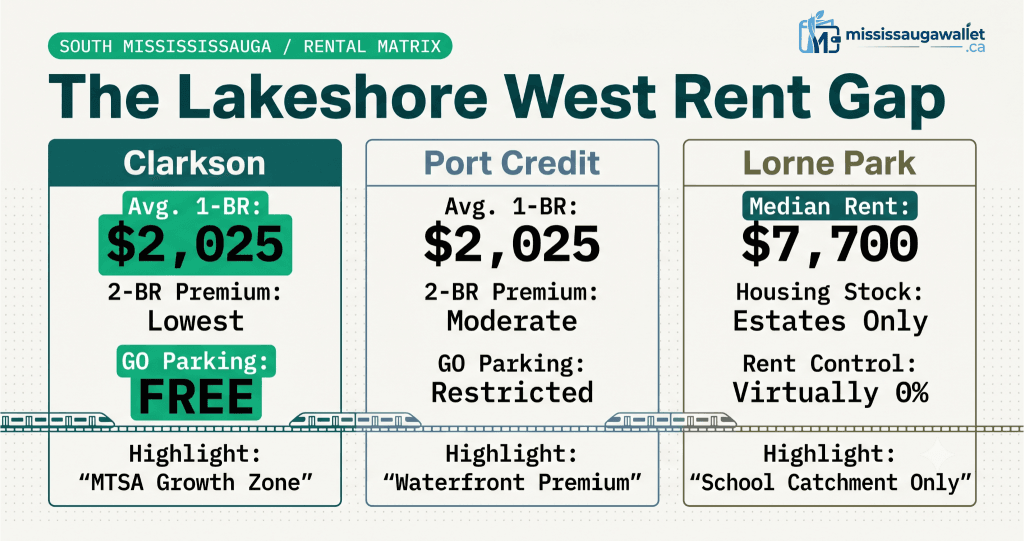
This guide previously used estimated Port Credit rents of $1,884 for a 1-bedroom, $2,158 for a 2-bedroom and $4,419 for a detached house, and unverified Clarkson estimates ($1,890–$1,960 for a 1-bedroom, $2,050–$2,240 for a 2-bedroom and an all-unit $2,150). On that basis it said the two neighbourhoods’ apartments were priced within a rounding error of each other. All Clarkson and Port Credit figures now come from Zumper’s 14 September 2026 reading: Port Credit $1,998 (1-bedroom), $2,350 (2-bedroom), $2,032 (all units); Clarkson $2,149, $2,450 and $2,199. Townhouse and detached estimates for both were removed, since no verified figure replaces them. Scenarios A and B were rebuilt on the 2-bedroom medians: the gap between them is $13 a month (previously stated as $126, then $217).
- Clarkson, Port Credit, and Lorne Park all sit within 10 km of each other on the Lakeshore West GO corridor, yet typical rents span only about $2,032 to $3,600 per month.
- Clarkson and Port Credit have essentially converged: on the 14 September 2026 reading their all-unit medians are $2,199 and $2,032, down sharply from spring 2026 when Port Credit carried a real premium.
- Unit by unit, Port Credit rents for $151 less than Clarkson for a 1-bedroom ($1,998 against $2,149) and $100 less for a 2-bedroom ($2,350 against $2,450). Gaps this size have reversed between readings a few weeks apart, so treat the two as priced about the same.
- Lorne Park’s median asking rent is about $3,600/month, roughly $1,401 to $1,568 above Clarkson and Port Credit, and under half the ~$7,600 median monthly mortgage on a home there. Its estate premium is capitalised into the purchase price, not the lease. What keeps renters out is inventory: only ~25% of residents rent, and just 13 rentals were listed at the time of writing.
- The GO fare from Clarkson to Union Station is $7–10 — within a dollar or two of Port Credit — making the transit advantage of paying any remaining Port Credit premium near zero.
- Clarkson GO is a designated Major Transit Station Area with an endorsed master plan, 2,434 new units proposed adjacent to the station, and Lakeshore West electrification coming. It is the neighbourhood most likely to reprice upward in the 2026–2031 window.
Why This Comparison Matters
South Mississauga contains one of the most financially misunderstood rental corridors in the Greater Toronto Area. Three distinct communities — Clarkson, Port Credit, and Lorne Park — occupy a narrow strip of land along Lake Ontario, share the Lakeshore West GO line, and collectively represent renting options from genuinely affordable to among the most expensive in the region. Yet most renters evaluate them in isolation, attracted to one neighbourhood’s reputation without running the numbers against the others.
The Port Credit article published earlier on this site established the financial profile of Mississauga’s most talked-about village. This article puts that profile into context — because the correct question for most renters is not “can I afford Port Credit?” but rather “what does each neighbourhood actually cost, and what am I buying with that difference?”
The Three Neighbourhoods: A Ground-Level Profile
Before the numbers, context. These are not interchangeable communities with different price stickers. Each has a distinct character, housing stock, and renter profile that shape who they work for financially.
The GO Train Question: Is the Port Credit Advantage Real?
The single most-cited reason renters historically paid a Port Credit premium over Clarkson is GO train access. Port Credit station is 28 minutes from Union Station. Clarkson is 35–38 minutes. The difference is 7–10 minutes, and in 2026 that time saving is close to the only thing left to weigh, since the rent gap for apartments has largely closed.
At face value, that seems minor. But the relevant financial question isn’t travel time — it’s cost. And on cost, there is almost no difference at all.
| Station | Distance to Union | PRESTO Fare (Adult) | Annual Cost (22 days/mo) | Station Parking |
|---|---|---|---|---|
| Clarkson GO | ~31 km · 35–38 min | $7–10 | ~$1,848–$2,640 | Free · 2,539 spaces |
| Port Credit GO | ~25 km · 28 min | $6–9 | ~$1,584–$2,376 | Limited · Construction disruption |
| Cooksville GO | ~28 km · 32 min | $6–9 | ~$1,584–$2,376 | Free parking available |
The annual GO fare difference between commuting from Clarkson versus Port Credit is approximately $264–$528 per year — or roughly $22–$44 per month. This is almost entirely offset by the fact that Clarkson GO offers free parking with 2,539 spaces, while Port Credit GO is currently subject to construction disruption from the LRT integration work, with temporary parking closures ongoing as of mid-2026.
For a driver who parks at the station: Clarkson’s free parking vs. the cost of getting to Port Credit GO (by car, bus, or cab) likely eliminates the fare differential entirely. For a cyclist or walker, both stations are accessible on foot from surrounding rental stock within 10–15 minutes. Use the MiWay vs. Driving Cost Calculator to model your specific commute numbers before deciding.
Port Credit GO station is currently a major construction hub where the GO Expansion program and the Hazel McCallion LRT integration intersect. A large underground “push box” structure is being excavated to allow the LRT tunnel to pass under the active GO tracks. This has caused temporary closures of station entrances, parking areas, and access points throughout 2025–2026. Renters moving to Port Credit specifically for GO access should factor in current disruption to station usability.
“The GO fare difference between Clarkson and Port Credit is about $22–$44 per month. In 2026 their rents have converged too, to within a few hundred dollars that shift between readings. The transit math never supported the old premium, and now the rent math barely does either.”
Rent by Unit Type: The Picture as of 14 September 2026
Comparing averages across all unit types distorts the picture because each neighbourhood has a different housing stock composition. Port Credit skews toward condos and apartments. Clarkson has a broader mix of older apartments, townhomes, and some detached rentals. Lorne Park is almost entirely large detached homes with a handful of estate rentals. Both Clarkson’s and Port Credit’s rents fell sharply through 2026. The 1- and 2-bedroom figures below are Zumper medians for both neighbourhoods from the same 14 September 2026 reading, so they compare like with like.
| Unit Type | Clarkson | Port Credit | Lorne Park |
|---|---|---|---|
| 1-Bedroom Apt | $2,149 median | $1,998 median | ~$1,400–$2,000* |
| 2-Bedroom Apt | $2,450 median | $2,350 median | ~$1,750–$5,000* |
| Townhouse | Not published | Not published | Thin sample* |
| Detached House | Not published | Not published | ~$3,600–$14,000* |
The headline is that Port Credit and Clarkson rent for about the same. On the 14 September 2026 reading Port Credit comes in $151 less for a 1-bedroom and $100 less for a 2-bedroom, but both neighbourhoods’ figures rest on fewer than 20 listings, and gaps that size have reversed between readings before. Port Credit’s limited townhouse and detached stock is the most likely place for any real premium to sit, but no verified figure puts a dollar amount on it. Solo renters and couples in apartments should treat price as close to a coin flip and decide on lifestyle instead. For the full neighbourhood-by-neighbourhood rent picture across Mississauga, see Renting in Mississauga in 2026: Which Neighbourhoods Still Have Deals.
Who Actually Lives in Each Neighbourhood — and Why It Matters for Renters
Housing stock composition isn’t just a data point. It determines whether rent-controlled units exist, what inventory looks like, how much negotiating room you have, and how stable your rent will be year-over-year.
Clarkson
Clarkson has a mixed stock of older apartment buildings (many pre-2018 and therefore rent-controlled), stacked townhomes, and newer condo units. The community hub is situated at Lakeshore Road West and Clarkson Road, and the Clarkson Village BIA has created a main street small village vibe along Lakeshore Road. Renters in older purpose-built buildings here benefit from Ontario’s 2026 rent increase guideline of 2.1% — a meaningful protection in a market that can spike. The housing stock north of Lakeshore is genuinely varied, from bungalows to townhomes, meaning more rental diversity than Port Credit’s more condo-dominant market.
Port Credit
Port Credit’s rental inventory is dominated by investor-owned condo units and older mid-rise apartment buildings along the Lakeshore corridor. Some buildings are pre-2018 and rent-controlled; newer condo towers are not. The waterfront-facing units carry a significant premium over inland equivalents on the same street. Inventory turns over faster here than in Clarkson — higher demand means landlords are less motivated to negotiate. In 2026’s softer market, some negotiation is possible, but Port Credit remains one of the tighter inventory neighbourhoods in Mississauga.
Lorne Park
Fewer people rent in Lorne Park than own, at 25.1% rent versus 74.9% own, and the median asking rent across the 13 listings on 25 August 2026 was about $3,600. The average home is listed at about $2,788,000, roughly 2.3 times Mississauga’s $1,188,000 average listing price, while homes that actually sold over the 56 days to 10 September 2026 averaged $1,776,846 (Zolo, 14 September 2026). That pairing is the whole story: rents sit within about $1,500 of the rest of the corridor while asking prices sit more than twice the city’s, because the estate premium is capitalised into the purchase price rather than the lease. Lorne Park rentals are almost exclusively houses on estate lots — a mix of basement and accessory suites and whole homes leased by owners temporarily away or testing the market before selling. They are not purpose-built rentals. This means no rent control (virtually all will be post-2018 or large homes exempt from the framework), no building superintendent, and lease terms set entirely at landlord discretion. It is a landlord’s market — but the binding constraint is supply, not price.
Nearly all Lorne Park rentals are large detached homes or estate properties — virtually none are purpose-built rental apartments. This means they are either post-2018 construction (exempt from rent control regardless) or fall outside the typical rent control framework by nature of the lease structure. If you rent a house in Lorne Park, assume your landlord has full flexibility to raise rent at lease renewal with 90 days’ notice. There is no structural protection against a significant increase.
The Full Monthly Budget: Three Scenarios at $120,000 Household Income
Below is a side-by-side monthly budget for a couple earning $120,000 combined gross ($78,000 take-home after tax, CPP, and EI) choosing between Clarkson, Port Credit, and Lorne Park, rebuilt with Zumper’s 2-bedroom medians for Clarkson and Port Credit (14 September 2026) and Lorne Park’s median asking rent. One car is owned. One person commutes to Toronto by GO train five days a week. Use the Mississauga Cost of Living Index to model these figures against your own income and spending profile.
The Lorne Park scenario is the one that surprises. At a $3,600 median asking rent, a $120,000 household clears roughly $750 a month rather than running a deficit, and the 30% rent-to-income benchmark is met at about $144,000 combined — higher than the other two, but nowhere near the $300,000-plus the sale prices would imply. Renting is how a household accesses Lorne Park without a purchase priced near $2.9M. What actually keeps renters out is availability: only a quarter of residents rent, and just 13 units were listed at the time of writing.
Between the Clarkson and Port Credit scenarios the gap is $13 a month in total spending, with Port Credit the dearer of the two. The rent lines alone favour Port Credit by $100; pricier groceries and discretionary spending in Port Credit, partly offset by Clarkson’s higher GO fare, account for the rest. On these figures the two budgets are effectively the same, which is the point: choose on the waterfront, the commute and the housing stock, not on rent.
What Clarkson Offers That Port Credit Doesn’t
Much of the south Mississauga conversation focuses on Port Credit’s advantages. Clarkson’s advantages are quieter and often overlooked. They are financially meaningful.
Free Parking at the GO Station
Clarkson GO Station has 2,539 parking spaces across a main lot, north lot, and parking garage, with free customer parking available. This is among the largest free commuter parking facilities in the Lakeshore West corridor. For a household that drives to the station — which is the typical pattern for Clarkson renters who live north of Lakeshore Road — this eliminates a cost that commuters from denser station areas routinely pay. Port Credit GO’s parking is significantly more limited and currently disrupted by construction. See The Real Cost of Owning a Car in Mississauga for a full breakdown of what commuting by car adds to your monthly budget.
An Older, More Rent-Controlled Rental Stock
Clarkson has a higher proportion of pre-2018 purpose-built rental buildings than Port Credit. In a market where the 2026 rent increase guideline is 2.1%, the difference between living in a controlled unit and a post-2018 condo tower is not theoretical — it compounds over years. A Clarkson renter in a 1985 apartment building paying $2,100/month today will pay a maximum of $2,144 next year. A Port Credit renter in a 2022 condo tower has no such protection.
A Growth Trajectory That Has Not Yet Been Priced In
On May 14, 2025, City Council endorsed a new master plan to shape growth and development for the area surrounding the Clarkson GO Station. More significantly, Infrastructure Ontario has proposed a new transit-oriented community for a 3.86-hectare site at 2130 Bromsgrove Road, directly adjacent to Clarkson GO — a plan that would introduce 2,434 new residential units in towers ranging from 25 to 45 storeys. Additionally, the Lakeshore West GO line will undergo changes to allow for electrification and 15-minute, all-day two-way service.
This trifecta — endorsed MTSA master plan, major transit-oriented community adjacent to the station, and GO electrification — puts Clarkson in a position structurally similar to what Cooksville was five years before the Hazel McCallion LRT was approved: a legitimately transit-rich node whose rents have not yet priced in the investment coming its way.
The Case for Renting Clarkson Before It Reprices
Three concurrent public-sector investments are converging on Clarkson GO station. The City-endorsed MTSA master plan formalizes the station area as a high-density growth node. Infrastructure Ontario’s 2,434-unit TOC proposal at Bromsgrove Road would be the largest development ever adjacent to the station — adding retail, public space, and a potential bus terminal. And GO Lakeshore West electrification will bring 15-minute all-day two-way service, dramatically improving the line’s utility for off-peak commuters and reverse commuters.
None of these developments have yet materially affected Clarkson rents. The neighbourhood’s asking prices remain at or below city median. Renters who secure pre-2018 rent-controlled units in Clarkson now will be protected from rent increases as the area densifies — the exact opposite of what happens to renters in post-2018 towers in areas that gentrify after they move in.
The window to rent in Clarkson at below-median prices in a rent-controlled unit is time-limited. It is not closed yet.
Lorne Park: Who Actually Rents Here, and Should You?
Lorne Park exists in this comparison for completeness and for one specific reason: a meaningful subset of Toronto-area renters target it deliberately, primarily for school catchment. The Lorne Park Secondary School and its feeder system are consistently among the top-ranked public schools in Peel Region, and some families rent specifically to access them while saving for a purchase in the area.
If you are considering Lorne Park for school catchment reasons, the financial picture is better than the sale prices suggest. The average home is listed at $2,788,000 and recent sales averaged $1,776,846, but the median asking rent is about $3,600, roughly $1,401 a month above Clarkson. Renting is the cheaper way into that catchment, and the ownership premium is not passed through to tenants in anything like proportion. The practical obstacle is supply rather than budget, so start looking well ahead of your move date and be ready to act when a listing appears.
For non-school-motivated renters, Lorne Park is simply not a financially viable option at most income levels. Rattray Park Estates south of Lakeshore Road is one of the most exclusive real estate pockets in Mississauga, and the rental market there reflects estate pricing, not utility-driven demand.
The Verdict: How to Choose
The Choice Is Now Lifestyle, Not Price — Except for Larger Units
In 2026 Clarkson and Port Credit have converged closely enough on rent that price alone rarely settles the decision anymore. Choose Clarkson if: you need a townhouse or detached house, you value rent control protection, you drive to the GO station, your grocery and errand trips are car-based anyway, or you want to lock in a rent-controlled unit before the area reprices around the MTSA master plan and GO electrification. For larger units Clarkson likely offers a discount, but this site has no verified figure for its size.
Choose Port Credit if: you are a solo renter or couple who will be genuinely car-free, you work at Union Station or a TTC-connected Toronto destination, you walk everywhere for groceries and errands, and the waterfront village atmosphere has tangible daily value to your lifestyle. Port Credit and Clarkson apartments rent within a few hundred dollars of each other on the latest reading, so for most apartment hunters the choice is lifestyle. Read The Real Cost of Living in Port Credit for the full financial breakdown of that neighbourhood.
Consider Lorne Park if: you want the school catchment or the estate-lot setting without a multi-million-dollar purchase, and you can wait out a thin, irregular rental market. At a $3,600 median asking rent it needs roughly $144,000 of household income to meet the 30% benchmark — more than Clarkson or Port Credit, but far less than its sale prices suggest — and the ownership premium that makes it one of Mississauga’s priciest places to buy is largely absent from its leases. Expect no rent control, no superintendent, and lease terms set entirely at the landlord’s discretion. Use the Mississauga Rent Affordability Matcher to confirm what rental price your income can sustainably support.
Action Checklist: Before You Sign a South Mississauga Lease
📋 South Mississauga Renter’s Checklist — 2026
- Clarify whether you actually need the shorter GO commute. The 7-minute difference between Clarkson and Port Credit is real but rarely the deciding factor once you account for the walk to the platform, wait time, and last-mile journey. Model your full door-to-desk commute time, not station-to-station.
- Run the rent control question before viewing. Ask landlords in all three communities: “When was this building or unit first occupied for residential purposes?” Buildings occupied before November 15, 2018 are covered by Ontario’s 2.1% guideline increase for 2026. Post-2018 units have no cap.
- For Clarkson: check the MTSA boundary. Units within the Clarkson GO Major Transit Station Area (roughly a 500–800m radius from the station) are in the highest-growth zone. Pre-2018 stock here offers both rent control and long-term neighbourhood upside.
- Budget for GO parking if driving to the station. Clarkson GO’s 2,539 free spaces mean parking costs zero. If you’re driving to Port Credit GO during construction, factor in alternative transport costs. GO reserved parking across the system runs approximately $94–$98/month where available. Use the MiWay vs. Driving Cost Calculator to model the full annual commuting cost for your specific route.
- For Lorne Park: get proof of school catchment in writing. If your motivation is school catchment, confirm your specific address falls within the target school boundary before signing. Boundaries can shift. The cost of being wrong at Lorne Park rental prices is significant.
- Use the current market to negotiate. All three neighbourhoods are in a softer 2026 market with vacancy elevated. In Clarkson especially, where investor-owned condo stock competes with purpose-built rentals, motivated landlords will negotiate. Ask for one month free on a 12-month lease or a 3–5% reduction from asking.
- Check Peel Region water billing. All three neighbourhoods receive Peel Region water and wastewater service. Confirm whether water is included in your rent or billed separately. In older Clarkson apartment buildings, water is frequently included. In newer condo units in all three neighbourhoods, it typically is not — budget an additional $40–70/month.
If you are deciding between a Clarkson or Port Credit rental based partly on transit access, use the MississaugaWallet MiWay vs. Driving Calculator to model your full annual transportation cost for your specific commute. Enter your Mississauga origin, your Toronto or Mississauga destination, and your car ownership profile. The calculator produces a 12-month comparison that accounts for fuel, insurance, parking, and PRESTO fare — specific to Mississauga routes.