
Is Mississauga Affordable? What the Cost-of-Living Data Actually Shows
“Is Mississauga a good place to live” isn't a financial question. This is: we pulled the city's actual rent, tax, and income numbers to answer whether Mississauga is cheap, expensive, or something in between — and what salary you actually need to live here.
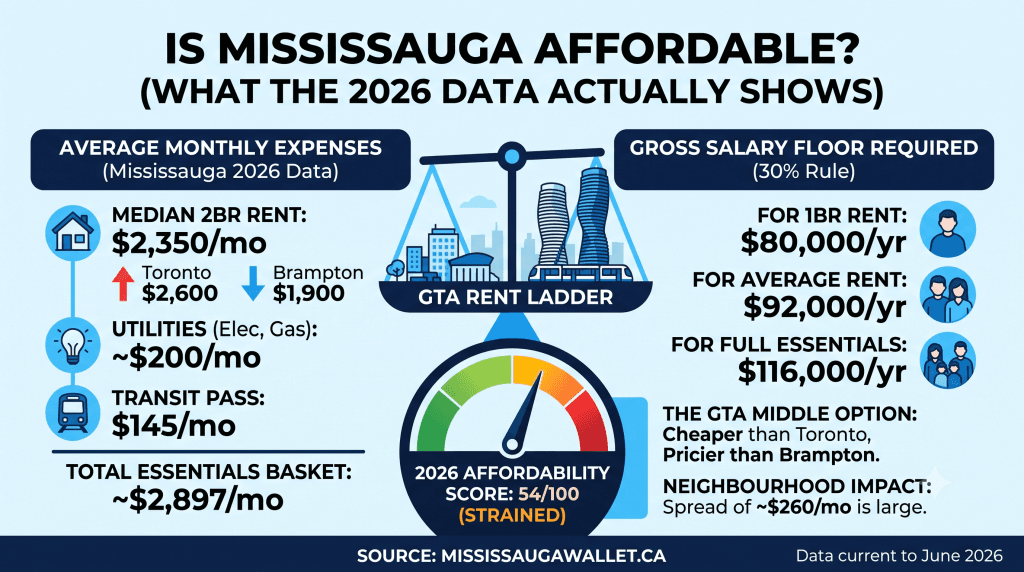
Search "is Mississauga a good place to live" and you'll get a wall of subjective takes about parks, schools, and vibe. That's not a financial answer. What actually determines whether Mississauga works for your budget is rent relative to income, how the city's costs stack up against Toronto and Brampton, and what income floor you need to clear before the math works. Here's what the numbers — pulled directly from our own Affordability Index and Cost of Living Index — actually show.
Update · 14 September 2026. This page previously stated Mississauga’s 1-bedroom and 2-bedroom rents as $2,000 and $2,350 (Door Insight, July 2026), while the neighbourhood figures beside them came from Zumper, and its city average as $2,342. The two sources measure differently, so the page now uses Zumper throughout wherever it states what a Mississauga unit costs, refreshed to Zumper’s 14 September 2026 reading: $2,027 for a 1-bedroom, $2,469 for a 2-bedroom and $2,300 across all units. On the 30% rule that is about $81,000 for a 1-bedroom (previously stated as $80,000), about $99,000 for a 2-bedroom ($94,000), about $92,000 at the city average ($94,000) and about $121,000 for the full essentials basket ($116,000). The Toronto and Brampton comparison still uses Door Insight for all three cities.
Is Mississauga a cheap place to live?
No — but it isn't the priciest option in the region either. Mississauga sits in the middle of the GTA rent ladder. As of July 2026, the median two-bedroom asking rent in Mississauga was $2,350/month, compared to $2,600/month in Toronto and $1,900/month in Brampton, according to Door Insight's market data. That puts Mississauga roughly 10% cheaper than Toronto on a like-for-like two-bedroom, but about 24% more expensive than Brampton next door.
| City | Median 2BR rent (July 2026) | vs. Mississauga |
|---|---|---|
| Brampton | $1,900/mo | –$450/mo cheaper |
| Mississauga | $2,350/mo | — |
| Toronto | $2,600/mo | +$250/mo more expensive |
Source: Door Insight rental market reports, July 2026. This comparison uses Door Insight throughout so all three cities are measured the same way; elsewhere on this page, Mississauga’s own bedroom rents come from Zumper.
The trend also favours renters right now. Mississauga's city-wide average rent is down 6% year-over-year, and one-bedroom units specifically have dropped 7% — the fastest-moving segment in the city. That's a genuine, if temporary, affordability tailwind — not a marketing claim. Whether that discount holds depends partly on the Hazel McCallion LRT's still-unconfirmed timeline, which tends to firm up rents once corridors open.
Mississauga is not cheap by national standards, but it's meaningfully cheaper than Toronto — roughly 10% on a comparable two-bedroom — while sitting well above Brampton. It's the classic "GTA middle" position: a real discount if you're leaving Toronto, a real premium if Brampton is your other option.
Is Mississauga an expensive city?
By national benchmarks, yes. Within the GTA, it's moderate. Mississauga's neighbourhood-level data shows how wide that range is, and how quickly it can move. On Zumper’s 14 September 2026 reading, the eleven neighbourhoods we rank run from $2,032 a month in Port Credit to $2,499 in Meadowvale, with the city average at $2,300. Which neighbourhoods sit at either end changes between readings: on 26 August the top was Meadowvale at a much higher figure, and Port Credit and City Centre, this site’s own past examples of Mississauga’s “premium” corridors, have both fallen below the city average in 2026.
That spread, about $467 a month on the latest reading, is the single biggest lever most residents have over their own cost of living. It's larger than most utility-switching or grocery-shopping optimizations combined, and it changes fast enough that “premium neighbourhood” reputations can go stale within a season.
Where the "expensive" reputation comes from
- Property taxes rose faster than rent in 2026. The combined City of Mississauga + Region of Peel + provincial education rate is 1.087901% of MPAC-assessed value for 2026 (City of Mississauga By-law 0061-2026) — a year-over-year increase that outpaced the rent correction.
- Transit costs have climbed too. The MiWay adult monthly pass rose from $141 to $145 in January 2026.
- The city's own Affordability Index score is 54 out of 100 — labeled "Strained," reflecting real pressure across housing, utilities, and transit even as some individual line items (gas, off-peak electricity) held flat or fell.
Mississauga is expensive relative to Canada as a whole, and moderate relative to the GTA. It's cheaper than Toronto but pricier than Brampton — and which neighbourhood you pick inside Mississauga moves your cost of living more than the city-vs-city comparison does.
What salary do you need to live in Mississauga?
Using the standard 30%-of-gross-income affordability guideline (the same threshold CMHC uses) applied directly to Mississauga's own 2026 rent data:
| Unit type | Median rent/mo | Gross income needed (30% rule) |
|---|---|---|
| 1-bedroom | $2,027 | ~$81,000/yr |
| 2-bedroom | $2,469 | ~$99,000/yr |
| 3-bedroom* | $3,000 | $120,000/yr |
| City-wide average (all units) | $2,300 | ~$92,000/yr |
| Port Credit (lowest of the eleven we rank) | $2,032 | ~$81,000/yr |
| Meadowvale (highest of the eleven we rank) | $2,499 | ~$100,000/yr |
Source: Zumper, Mississauga and neighbourhood rent research read 14 September 2026. 1- and 2-bedroom figures are city-wide medians; the neighbourhood rows are all-unit averages. *The 3-bedroom figure is Door Insight’s July 2026 median, because Zumper’s is not in our verified data. Income needed applies the 30% rule to twelve months of rent.
That's the rent-only floor. It doesn't yet cover groceries, utilities, or transit. Our Affordability Index models a full essentials basket for a typical two-bedroom renter household: $2,469 rent + $85 electricity + $117 gas + $145 transit + ~$200 other essentials, totalling roughly $3,016/month, with rent alone about 82% of it. Hold that full basket to the same 30% target and the income floor rises to approximately $121,000/year — a more realistic number for a household covering all its fixed costs, not just rent.
Property tax adds a separate, MPAC-driven cost. At the 2026 combined rate of 1.087901%, a $700,000 assessed home owes approximately $7,615/year in property tax alone — before mortgage, utilities, or maintenance. Run your specific assessed value through the Property Tax Estimator.
For a precise number based on your own household — your unit size, transit choice, and utility usage — run it through the Rent Affordability Matcher or build your full monthly baseline with the Cost of Living Index.
How to actually improve your affordability picture
- Compare neighbourhoods before you compare cities. The $538/month gap between Lakeview and Meadowvale is bigger than most other savings levers available to you — and don't assume last year's "premium" neighbourhood is still expensive. See the full neighbourhood hub index.
- Check MiWay's Affordable Transit Program. Residents below the Low Income Measure qualify for 50% off adult monthly passes — $72.50 instead of $145.
- Switch to Alectra's Ultra-Low Overnight rate if you can shift laundry, dishwasher, or EV charging to overnight hours — see the full rate plan comparison.
- If you own, check your MPAC assessment. Assessments are frozen at January 1, 2016 values — a successful Request for Reconsideration can permanently lower your annual bill.
- Run your own number before signing a lease. The Rent Affordability Matcher factors in transit and utility costs most rent-to-income rules of thumb ignore.
Mississauga is not a cheap city, but it isn't Toronto either. City-wide rent is down 6% year-over-year, sitting about 10% below comparable Toronto units and 24% above Brampton. To comfortably afford the average Mississauga rent alone, you need roughly $92,000/year; to cover a full essentials basket (rent, utilities, and transit), plan for closer to $121,000/year. Which neighbourhood you choose moves that number by tens of thousands of dollars more than the city-level comparison ever will — and which neighbourhood is cheap can flip within months, so check current data rather than reputation.
Frequently asked questions
Is Mississauga a cheap place to live?
Not cheap, but not the GTA's most expensive city either. On Door Insight's July 2026 figures, Mississauga's median two-bedroom rent ($2,350/month) runs about 10% below Toronto's ($2,600/month) but roughly 24% above Brampton's ($1,900/month). City-wide rent is also down 6% year-over-year, which has created a temporary affordability window — including in Port Credit and City Centre, which carried a "premium neighbourhood" reputation as recently as early 2026 and now rent below the city average.
Is Mississauga an expensive city?
Relative to Canada overall, yes — Mississauga's Affordability Index currently sits at 54 out of 100 ("Strained"), reflecting rising property taxes (1.087901% combined 2026 rate) and transit fares even as some utility costs eased. Relative to the rest of the GTA, it's moderate: cheaper than Toronto, pricier than Brampton, with a roughly $538/month spread between its most and least expensive neighbourhoods.
What salary do you need to live in Mississauga?
Using the standard 30%-of-gross-income rule against 2026 rent data, you need approximately $81,000/year for a one-bedroom, $99,000/year for a two-bedroom, or about $92,000/year at the city-wide average rent of $2,300/month (14 September 2026). Factoring in utilities and transit alongside rent for a full essentials budget raises that to roughly $121,000/year for a typical two-bedroom household. Homeowners should also budget separately for property tax — about $7,615/year on a $700,000 MPAC-assessed home at the 2026 combined rate.
All figures sourced from MississaugaWallet.ca's Affordability Index and Cost of Living Index (data current to August 2026), Zumper neighbourhood rent research (August 2026), Door Insight rental market reports (July 2026), and the City of Mississauga 2026 property tax by-law (By-law 0061-2026). Figures are estimates for general informational purposes only, do not constitute financial advice, and should be verified against your specific circumstances before making a decision.