
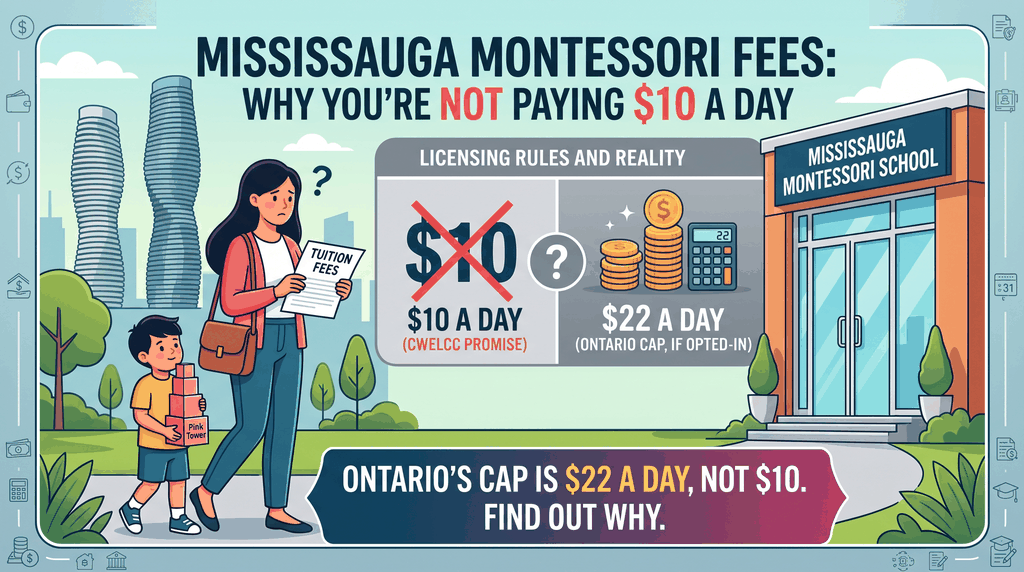
You have read that child care in Ontario is heading to $10 a day. Then you call a Montessori school in Mississauga and the number you hear is nothing like that — if you can get a number at all. Both things are true at once, and the reason is a licensing distinction that almost nobody explains to parents.
This guide covers what the cap actually is, the rule that decides whether your school is bound by it, what Mississauga Montessori schools publish when you go looking, and how to check your own centre before you put down a deposit.
$10 a Day Is Not the Price Anywhere in Ontario
Start here, because it clears up most of the confusion. $10 a day is a target, not a rate. The Canada-Wide Early Learning and Child Care plan set out to reach a $10 average, and Ontario has not got there. The original deadline was March 2026; staffing shortages and a shortfall in new spaces pushed it back, and the federal and provincial agreement was extended to 31 December 2026.
What exists in the meantime is a cap. Region of Peel states it plainly: "Since January 2025, the maximum daily cost for families is $22." The Canadian Centre for Policy Alternatives, in its August 2026 review of fees across the country, found the same thing province-wide — parents in Ontario cities, Mississauga included, pay $22 a day for a CWELCC space.
So the honest comparison for a Mississauga parent is not $10 against your Montessori invoice. It is $22 a day against your Montessori invoice — roughly $478.50 a month once you spread it across the 21.75 weekdays in an average month.
$22 × 21.75 weekdays = $478.50 a month. If a Mississauga centre quotes you a full-day monthly fee at or very near that figure for a child under six, you are almost certainly looking at the CWELCC cap rather than the school's own pricing. Anything materially above it means one of two things — and the next section is how to tell which.
The Licensing Rule That Decides Your Invoice
CWELCC does not apply to "child care" as a general idea. It applies to centres licensed under the Child Care and Early Years Act. That single fact explains nearly every confusing fee you will encounter, because Montessori schools in Ontario sit on both sides of it.
A licensed child care centre that opted in
These hold a Child Care and Early Years Act licence and signed the CWELCC agreement. For children under six, they cannot charge more than the cap. This is the majority of licensed care in Peel — the Region reports 95% of its licensed providers participate.
A licensed child care centre that did not opt in
Participation is voluntary. A centre can hold the licence and decline the agreement, in which case it sets its own fees. Peel is blunt about the consequence: "If your child care provider is not enrolled in the CWELCC plan, your costs will not be reduced."
A private school operating under the Education Act
This is the case parents almost never see coming. A Montessori programme run as a private school under the Education Act is not licensed child care at all. It is not eligible for CWELCC regardless of how young its students are — a three-year-old in a private-school Casa programme is, for funding purposes, a private-school student rather than a child in licensed care. There is no opting in. The cap simply does not reach it.
The 95% figure counts licensed providers. A Montessori operating as a private school was never in that denominator. So a school can sit outside CWELCC entirely while the regional participation rate stays near-universal — the two statements are not in tension, and quoting the 95% back to a school that is not licensed child care will not get you anywhere.
What Mississauga Montessori Schools Actually Publish
The most striking thing about researching this is how little is published. Below is what three Mississauga Montessori schools showed on their own fee pages, read directly on 2 September 2026.
| School | What its fee page shows | Full-day fee |
|---|---|---|
| Inspire Montessori Mississauga | Full schedule published. Toddler (15 months–2.5), Jr. Casa (2.5–4) and Sr. Casa (4–6) all at one rate, HST included, lunch and two snacks included. Cites CWELCC. | $478.50 / month |
| Kaban Montessori | No fees shown. "Tuition varies by program" behind a request form. | Not published |
| Prince Edward Montessori (Mississauga campus) | No fee schedule shown. A $500 registration fee and a last-month deposit are stated; before and after care is extra. | Not published |
Look at that first row again. $478.50 a month is exactly $22 a day across 21.75 weekdays — the cap, to the cent, and the school identifies itself as a CWELCC participant. That is what a Mississauga Montessori looks like when it is inside the system.
The other two rows are the more common experience, and they are the reason this is hard to research: two of the three schools will not tell you the price without a conversation. That is not necessarily a red flag, but it does mean you cannot compare schools from your sofa, and it makes the licensing question something you have to ask about directly rather than infer.
Search for Mississauga Montessori tuition and you will find aggregator sites quoting annual ranges in the five figures. Those are third-party estimates covering the whole province, not Mississauga fee schedules, and this guide does not repeat them. The figures in the table above are the ones the schools themselves published. Everything else, get from the school in writing.
Toddler Montessori Fees: The Same Cap as Preschool
Parents often expect toddler rooms to cost more, and outside the cap they usually do, because Ontario requires more staff per child for younger children. Inside CWELCC the age does not change the ceiling. The $22-a-day maximum applies to every child under six in an enrolled centre, toddlers included.
Inspire shows this directly. Its Toddler (Pre-Casa) programme for 15 months to 2.5 years is published at $478.50 a month, the same figure as its Junior and Senior Casa rooms, rechecked on 26 September 2026. Kaban runs a toddler programme for 18 to 30 months and still publishes no fee for it. So a toddler quote well above $478.50 tells you the same thing as a preschool one: the school is outside CWELCC, and the next question is why.
The Price Is Only Half the Question
Everything above is about what a space costs. The other half of the problem is whether you can get one, and for budgeting purposes the two are not separable.
CWELCC caps what a centre may charge. It does not create the space. That is the same shortfall — too few new spaces, too few registered early childhood educators — that pushed the $10 target past its March 2026 deadline in the first place. And a capped price with more families than places has an entirely predictable consequence: the cheapest spaces are rationed by waiting rather than by price. The $478.50 room and the room you can start in next month are frequently not the same room.
Two families in the same neighbourhood, both wanting care for a three-year-old, can face completely different numbers — not because one negotiated better, but because one got a licensed CWELCC place and the other took what was available. Plan for the timeline, not just the fee. If you are budgeting for a start date within a few months, the honest planning figure is what you would pay at a centre that can actually take your child on that date.
Three practical consequences:
- Get on lists earlier than feels reasonable, and ask each centre for your position on it in writing. A verbal "we should have something" is not a plan.
- Availability and price tend to move in opposite directions. A school that can start your child next week is worth exactly one extra question — is this a licensed CWELCC space, or is the opening there because the fee is uncapped?
- Do not read a fast offer as a bad school, or a long wait as a good one. Waiting lists reflect capped prices and local demand. They are not a quality ranking, and a private Montessori with space is not thereby worse than a licensed one without.
How to Check Your Own Centre in Four Steps
- Ask the school one precise question. Not "do you take the subsidy" — ask "Are you licensed under the Child Care and Early Years Act, and are you enrolled in CWELCC?" Those are two separate yeses, and you need both for the cap to apply.
- Check the provincial licence yourself. Ontario runs a public licensed child care search at earlyyears.edu.gov.on.ca. If the centre is not there, it is not licensed child care, and CWELCC is not available to it.
- Check Peel's list of participating providers. The Region publishes which licensed providers are enrolled in CWELCC, alongside its own child care search. Peel Children's Services is on 905-793-9200.
- Call InfoPeel if you want a human. Child Development Resource Connection Peel — the CDRCP that turns up in a lot of searches — is a non-profit at 75 Watline Avenue in Mississauga, and it is a different organisation from the Region. Its InfoPeel line is 905-890-9432 (TTY 905-890-8089), open 8:30 a.m. to 5 p.m. Monday to Friday, with support in up to 200 languages. It runs the Peel Early Learning and Child Care Directory and will search it with you, which is the fastest way to find licensed centres near an address.
Can You Use Peel's Child Care Fee Subsidy at a Montessori?
Yes, if the Montessori is a licensed child care centre. No, if it is a private school. The subsidy follows the Child Care and Early Years Act licence, the same test that decides the CWELCC cap. Whether the school calls itself Montessori makes no difference either way.
The fee subsidy is a separate programme from the CWELCC cap, and the two stack. Peel's Child Care Subsidy reduces what you pay for licensed child care for children 12 or younger, income-tested against your previous year's tax return. To qualify you need to be living in Peel and working, in school, or managing a documented medical or social need.
The order matters, and it is the part most people get backwards. CWELCC is applied first, to the centre's base fee. The subsidy then reduces what is left of your share, according to the income test in O. Reg. 138/15 — so subsidy works on the already-reduced amount, not on the sticker price. Peel is explicit that you can receive subsidy even if you already have reduced fees through CWELCC. Both, though, are gated on the same thing: a space licensed under the Child Care and Early Years Act. Neither reaches a private school.
The word doing the work there is licensed. Subsidy follows the licence, not the CWELCC agreement — so a licensed centre that stayed out of CWELCC is a different situation from a private school, and worth asking Peel about directly rather than assuming. If your Montessori is a private school under the Education Act, neither the cap nor the subsidy is available, and no application will change that. In that case the fee is the fee, and your levers are the school's own sibling discounts, payment plans and bursaries.
Run Ontario's legislated income test on your own numbers — your monthly parent contribution, the CWELCC reduction, and what licensed care costs you after subsidy.
For the full picture of how the cap, the subsidy and the city's recreation credits stack together, see our guide to Mississauga childcare costs.
One Date to Keep in View
The extended CWELCC agreement runs to 31 December 2026. What replaces or extends it after that has not been settled, and the $10 target has already moved once. If you are choosing a school now for a placement that runs past that date, treat the $22 cap as the rule for today rather than a permanent feature — and ask any school quoting you a capped fee what happens to your invoice if the agreement changes.
Ask about the licence, not the price
The gap between $22 a day and a private Montessori invoice is not a negotiation — it is a licensing category. A school either holds a Child Care and Early Years Act licence and signed the CWELCC agreement, or it does not. Everything about your fee follows from that.
$478.50 a month is the tell. A full-day monthly fee at that figure for an under-six is the cap, not the school's price. Well above it means the school is outside CWELCC — ask which of the two reasons applies.
Get the fee schedule in writing before you pay a registration fee. Two of the three Mississauga schools checked here charge a deposit or a $500 registration fee without publishing a rate anywhere on their site.
Budget for the space you can actually get. A cap on the price is not a supply of places, and the cheapest rooms carry the longest waits. If you need a start date in the next few months, plan around what a centre with an opening will charge you.
Reference Sources
- Region of Peel — lower child care fees / CWELCC: the $22 daily maximum in place since January 2025, the 95% participation figure, under-six eligibility, and the statement that fees are not reduced at non-enrolled providers.
- Region of Peel — Child Care Subsidy: licensed care, children 12 or younger, eligibility conditions, and Children's Services at 905-793-9200.
- Province of Ontario — Licensed Child Care Search (earlyyears.edu.gov.on.ca), for verifying that a centre holds a Child Care and Early Years Act licence.
- Canadian Centre for Policy Alternatives — The $10-a-day divide: Child care fees in Canada in 2026, published 19 August 2026, for the $22 figure across Ontario cities.
- School fee pages for Inspire Montessori Mississauga, Kaban Montessori and Prince Edward Montessori (Mississauga campus), each read directly on 2 September 2026.
- Child Development Resource Connection Peel (CDRCP), 75 Watline Avenue, Mississauga — InfoPeel on 905-890-9432, TTY 905-890-8089, 8:30 a.m. to 5 p.m. weekdays, and the Peel Early Learning and Child Care Directory it maintains. CDRCP is an independent non-profit, not part of Region of Peel.
- Region of Peel — Child Care Subsidy and CWELCC are applied in that order: the CWELCC reduction comes off the base fee first, then the income test in O. Reg. 138/15 reduces the parent's remaining share. Peel states that families can receive subsidy alongside CWELCC-reduced fees.
- Availability: this guide does not publish a waiting-list length, because no current Peel-wide figure was verifiable at the time of writing. The section on availability describes how a capped fee interacts with demand, and the space and educator shortfall already cited above as the reason the $10 deadline moved.