
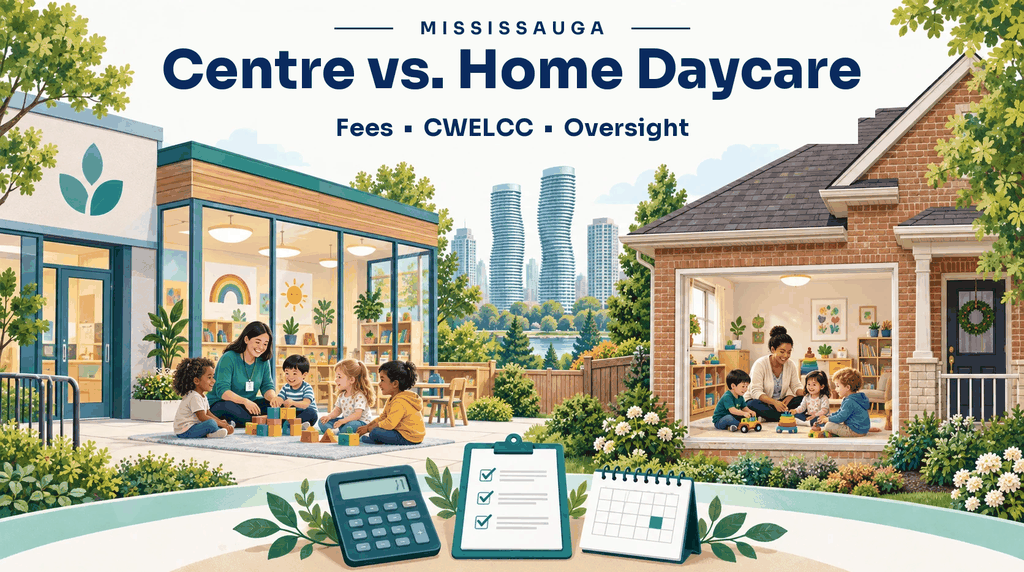
Many parents across Mississauga assume that home daycare is the lower-cost alternative to a commercial child care centre. Under Ontario's Canada-Wide Early Learning and Child Care (CWELCC) system, the financial reality is often the exact opposite: a home daycare can be either identical in price to a commercial centre, or far dearer with no ceiling at all, depending entirely on a single regulatory status.
A licensed centre and an agency-affiliated home child care provider in Peel Region both cap their base rates at $22 a day. An independent, unlicensed home provider cannot access provincial funding at all, sets its own rate, and is bound by no ceiling. Below is how the three care models differ in daily cost, legal safety ratios, sick-day policies, and infant availability across Mississauga.
The Three Childcare Models in Mississauga
Every child care option operating in Mississauga falls under one of three regulatory structures established by the Child Care and Early Years Act, 2014 (CCEYA). That classification dictates what you pay, how many children can share the room, and whether public subsidies apply.
1. Licensed Child Care Centres
These are commercial or non-profit facilities operating in dedicated buildings, community hubs, or schools. The Ministry of Education licenses the specific facility, conducts unannounced annual inspections, and mandates that staff include qualified Registered Early Childhood Educators (RECEs). Roughly 95% of licensed child care centres in Peel Region participate in the CWELCC fee-reduction program.
2. Licensed Home Child Care (Agency-Affiliated)
In Ontario, individual home child care providers are not licensed directly as independent commercial operators by the province. Instead, an approved Licensed Home Child Care Agency holds the provincial licence. The agency screens homeowners, conducts criminal background and health checks, inspects the physical premises, provides ongoing RECE home advisor visits, and executes the CWELCC funding agreement with the Region of Peel. For families, the daily fee is bound by the provincial cap, and payments go through the agency rather than directly to the homeowner.
3. Independent / Unlicensed Home Daycare
An individual can legally provide child care in their private home without a provincial licence, provided they care for no more than five children under the age of 13, of whom no more than three may be under age 2, counting their own children under age 4. These providers set their own rates, establish their own operating hours, and carry no provincial oversight. Under the CCEYA, unlicensed providers are legally required to inform parents in writing that they are not licensed by the Ministry of Education. Crucially, unlicensed home daycares cannot participate in CWELCC, meaning parents receive zero provincial fee reductions.
A home daycare is either tied to a licensed agency or it is independent. If it is tied to an agency enrolled in CWELCC, you pay a maximum of $22 a day ($478.50 a month). If it is independent, you pay whatever that provider sets, with no ceiling and no subsidy of any kind. Always ask an in-home provider for the name of their licensed agency before discussing fees.
Head-to-Head Comparison: Costs, Ratios, and Operations
The table below breaks down the structural differences between licensed centres, agency home care, and independent private home daycares operating in Mississauga.
| Feature | Licensed Centre | Licensed Home (Agency) | Unlicensed Home (Independent) |
|---|---|---|---|
| CWELCC Fee Cap | $22/day (Ontario avg ~$19) | $22/day (Ontario avg ~$19) | Ineligible (Uncapped) |
| Monthly Cost (21.75 days) | $413–$478.50 | $413–$478.50 | Uncapped; no rate is publicly tracked |
| Region of Peel Subsidy | Eligible (stacks on CWELCC) | Eligible (stacks on CWELCC) | Ineligible |
| Maximum Group Size | 10 (infant), 15 (toddler), 24 (preschool) | 6 children, max 3 under age 2 (incl. own under 4) | 5 children, max 3 under age 2 (incl. own under 4) |
| Provincial Inspections | Annual unannounced inspection | Agency home visits, at least quarterly | None (complaint-based only) |
| Capacity for under-2s | 10 per infant room, needing 3 educators | Up to 3, within the 6 | Up to 3, within the 5 |
| Backup for Provider Illness | Centre stays open (supply staff) | Home closes; no agency back-up is required | Closed; parents arrange backup |
| Operating Hours | Strict (typically 7:00 AM – 6:00 PM) | Often flexible / negotiable | Flexible / negotiable |
Why the unlicensed column has no price
Unlicensed providers are not licensed, not inspected on a schedule, and not funded, so no level of government collects what they charge. The Region of Peel does not publish a figure, Ontario does not, and the aggregator sites that appear to are not sources this site will cite. Any single number you see quoted for unlicensed home daycare in Mississauga is somebody's anecdote.
Two published figures give the nearest honest bracket. Statistics Canada put full-time home-based child care at $534 a month nationally in 2025, but that blends CWELCC-capped licensed homes with unlicensed ones, so it sits below what an uncapped provider charges. At the other end, Global Child Care Services, a licensed Ontario agency, publishes $55.11 a day for a full day of home child care at an age CWELCC does not cover, effective 1 January 2026. That is home child care priced without the cap, by an agency that has to publish its rates.
Treat anything in that bracket as plausible and anything outside it as worth questioning. Ask the provider directly, in writing, and compare it against the $22 you would pay through an agency.
The Infant Squeeze, and Why Nobody Can Tell You the Wait
Licensed centres and agency home daycares share the same $22 daily cap, so for a child under two the question stops being price and becomes whether a space exists at all. Be warned before you read further: no one publishes a waiting time for Mississauga. The Region of Peel does not publish one, and in its 1 October 2025 audit the Auditor General of Ontario told the Ministry of Education to start tracking spaces, utilization and waitlists, which is not advice you give a ministry that already does. Peel's own published guidance is simply to apply at least four weeks before you need care.
What the regulations do fix is capacity. A licensed centre infant room takes at most 10 babies and requires three educators to do it, the most staff-intensive ratio in the sector. An agency home provider may take up to three children under age two inside their six-child limit. Those numbers are law, and they are why infant spaces are the first to run out.
The binding constraint is staff, not buildings. The same audit found that in 2023, 43% of centres enrolled in CWELCC were operating below 80% of their licensed capacity, primarily because they could not hire. Licensed infant spaces exist on paper that no centre can legally open without a third educator in the room.
Where other Ontario regions do run a central waitlist, the numbers have grown sharply since the $10-a-day program began: roughly 15,000 children waiting in Waterloo as of September 2026, about 8,500 in Ottawa, and 1,235 waiting for an infant space in Thunder Bay. Peel runs no equivalent public list, so treat those as evidence of the direction of travel elsewhere rather than as a Mississauga number.
The practical response is to apply to licensed centres and to several licensed home child care agencies at the same time, as early in a pregnancy or leave as the provider will accept you, and to ask each one in writing where you sit on its list. An agency placement and a centre placement cost the same, so there is no reason to queue for only one of them.
Because no unlicensed rate is published, the figure below is an illustration, not a market average. It assumes $55 a day, close to the $55.11 a licensed agency charges for a full day where no cap applies, and an assumed six-month wait, because no published Mississauga waiting time exists. If a parent returning to work cannot secure a CWELCC-capped spot and pays that rate for six months:
($55 − $22) × 21.75 days × 6 months = $4,306.50 in extra out-of-pocket costs.
Run it again with the rate you are actually quoted. Every dollar a day above $22 costs roughly $21.75 a month.
Targeting both licensed centres and licensed home agencies from the beginning of your pregnancy or leave is the practical safeguard against paying that interim penalty.
Licensed Home Child Care Agencies Serving Peel Region
If you want home-based child care at the $22-a-day capped rate, you must register through a licensed agency. InfoPeel's licensed home child care directory lists 15 agencies serving Mississauga. Others in that directory operate only in Brampton or Caledon, so check the municipality before you call. Four of the Mississauga-listed agencies:
- Wee Watch (Mississauga East & Mississauga West): A prominent agency system across Ontario, Wee Watch screens providers, runs its own home visitor inspections, enforces equipment standards, and publishes a CWELCC-reduced rate of $22 a day for children under six.
- Family Day Care Services: A long-standing accredited non-profit agency operating licensed home child care networks across Peel Region, with full CWELCC participation and subsidy support.
- Caring for Kids Child Care Services: A non-profit agency contracted in Peel Region providing vetted home child care providers in Mississauga and Brampton.
- Today's Family: A non-profit agency listed for Mississauga and Brampton, operating licensed home child care alongside its centre-based programs.
Not every listed agency offers subsidized placements, and CWELCC participation is agreed agency by agency, so confirm both before you commit. Check an agency's active licence through Ontario's Licensed Child Care Search, and see the full Mississauga list on InfoPeel's licensed home child care directory. InfoPeel is operated by the Child Development Resource Connection Peel (CDRCP) at 75 Watline Avenue, Unit 103, Mississauga (phone: 905-890-9432).
Sick Policies and Sickness Frequency
For working parents in Mississauga, days lost to child illness represent a major hidden financial cost. Here, the trade-off between centres and home daycares cuts in two distinct directions.
Fewer infections now, or fewer later
A centre runs several age-grouped rooms at once. Ontario's maximum group sizes (10 infants, 15 toddlers, 24 preschoolers, 26 kindergarten children) mean even a modest centre holds 50 to 100 children behind one front door, sharing hallways, a playground and an entryway. A home child care setting caps total exposure at a pod of five or six.
The obvious conclusion, that the smaller pod means less illness, is only half right, and the research that tests it is Canadian. Following 1,238 families from birth, Côté and colleagues (Archives of Pediatrics & Adolescent Medicine, 2010) found children who started large-group care before age two and a half had more respiratory and ear infections as young preschoolers, the same rate as everyone else in late preschool, and fewer infections once they reached elementary school. Small-group care showed no significant difference at any stage.
So the illness is largely deferred rather than avoided, and it is deferred from a period when you burn vacation days to a period when your child misses school. That is a real trade-off, but it is not the straightforward win for home care that it first looks like, and it is not a reason on its own to choose one model over the other.
Who stays open when somebody is sick
This is the difference that actually costs money, and it runs the other way. When an educator at a licensed centre is ill, the centre deploys supply staff and stays open. When a home child care provider is ill, the home closes.
Being with an agency does not fix this. Ontario's Home Child Care Agency Licensing Manual requires an agency to recruit, monitor and support its providers, and to send a home visitor to inspect each premises before any child is enrolled and at least once every three months afterwards. It sets no requirement to arrange alternate or back-up care when a provider is sick or on vacation. Some agencies offer it as a service and some do not, so it is a question to ask by name rather than a feature to assume. Whatever the answer, get it in writing before you sign.
Run Ontario's legislated income test on your household earnings and see your net daily cost for both licensed centres and agency home daycares.
How the Region of Peel Subsidy Stacks on Home Care
If your household qualifies for the Region of Peel Child Care Subsidy, that financial relief is not restricted to commercial centres. It applies equally to licensed home child care contracted through an approved agency.
The two funding mechanisms stack in a specific sequence:
- CWELCC reduces the base fee first: The agency's base fee is reduced to the $22-a-day cap (or lower regional average).
- The Peel subsidy reduces the parent contribution second: Peel calculates your parental share based on Line 23600 (net income) of your most recent CRA Notice of Assessment under O. Reg. 138/15. For qualifying low- to moderate-income households, that payment can fall to nothing: once the income test and the under-six reduction are applied, any parent contribution below $10 a month is rounded down to zero under s. 10 (2) (b).
Because unlicensed home daycares have no relationship with the Region of Peel, no subsidy can be applied to an independent home provider. A family qualifying for a full subsidy would pay $0 at a licensed centre or agency home, but would pay the full $1,100+ monthly fee at an independent home daycare.
5 Questions to Ask Before Placing a Deposit
Before placing a deposit or signing an agreement with an in-home child care provider in Mississauga, ask these five specific questions:
- "Are you contracted with a licensed agency, or are you operating independently?" If they are independent, clarify immediately that you understand they are unlicensed and ineligible for CWELCC.
- "Which licensed agency holds your contract, and are they enrolled in CWELCC?" If they name an agency, confirm that their specific contract is currently covered under the fee reduction agreement.
- "How many total children will be in your home during operating hours, including your own children under age 4?" Under Ontario law, an unlicensed provider cannot exceed 5 children and a licensed agency provider cannot exceed 6, and neither may have more than 3 children under age 2. An operator exceeding these counts is in violation of provincial law.
- "What is your backup protocol when you are unwell or taking vacation?" Verify whether an agency provides alternate placement or whether you are solely responsible for finding emergency care.
- "What written disclosure or contract will I receive before my child starts?" Unlicensed providers must furnish written notice stating they are unlicensed. Agency providers will provide an official agency parent agreement outlining base fees and non-base charges.
The $22 ceiling is not permanent. Canada and Ontario aimed for an average of $10 a day per child under six by March 31, 2026, and missed it. On December 4, 2025 the agreement was extended to March 31, 2027, with $695 million in federal funding holding eligible fees at the Ontario average of $19 a day through December 31, 2026. The legal ceiling on a CWELCC base fee stays at $22 a day. Every comparison on this page holds through the end of 2026, so recheck the cap in January 2027 before budgeting past it.
Understand the agency distinction
Home care is not automatically cheaper or pricier. The agency makes the difference. An agency-affiliated home child care provider gives you the same $22-a-day CWELCC fee cap and subsidy eligibility as a large centre, in a smaller home setting with a maximum of six children.
Queue in both lines at once. An agency home placement and a centre placement cost the same $22 a day, so apply to licensed centres and to several licensed home child care agencies in parallel rather than waiting on one. Nobody publishes a waiting time for Mississauga, so ask each provider where you sit on its list and get that answer in writing.
Weigh the $4,300 waitlist cost. If you take an unlicensed home spot while waiting for a centre, price the premium yourself: every dollar a day above the $22 cap is about $21.75 a month, and none of it is subsidized. Ask for your numeric position on CWELCC waiting lists in writing every two months.
Verify before paying. Confirm any provider's agency affiliation on the provincial registry at earlyyears.edu.gov.on.ca or through InfoPeel on 905-890-9432 before transferring a deposit.
Reference Sources
- Province of Ontario. Child Care and Early Years Act, 2014 (CCEYA) and Ontario Regulation 137/15 (General): legal ratios, group sizes, home child care capacity limits, and mandatory written disclosure rules for unlicensed providers.
- Region of Peel. Early Years and Child Care Services: CWELCC $22/day maximum fee policy, participating provider lists, and Licensed Home Child Care Agency standards.
- Province of Ontario. Licensed Child Care Search (earlyyears.edu.gov.on.ca), Ministry of Education registry of licensed centres and licensed home agencies.
- Region of Peel. Child Care Subsidy Policy and Ontario Regulation 138/15: Line 23600 income-test calculations and guidelines for stacking subsidies on CWELCC base fees.
- Province of Ontario. Home Child Care Agency Licensing Manual (January 2025): agency duties, the requirement to inspect each premises at least once every three months, and the absence of any back-up care requirement.
- Côté SM et al. Short- and long-term risk of infections as a function of group child care attendance, Archives of Pediatrics & Adolescent Medicine, 2010: an eight-year study of 1,238 Canadian families.
- Office of the Auditor General of Ontario. Canada-Wide Early Learning and Child Care Agreement, special report released 1 October 2025: capacity utilization, staffing shortages, and the recommendation to track spaces, utilization and waitlists.
- The Canadian Press, 15 September 2026: central waitlist counts reported by the Region of Waterloo, Ottawa and Thunder Bay, four years into the $10-a-day program.
- Statistics Canada. Child care arrangements, 2025 (released 21 October 2025): national average monthly cost of full-time home-based and centre-based child care, and the share of home-based providers that are unlicensed.
- Global Child Care Services. Published home child care fee schedule effective 1 January 2026: the $22 CWELCC rate and the uncapped full-day rate for ages CWELCC does not cover.
- Child Development Resource Connection Peel (CDRCP). InfoPeel early learning directory and community resources (75 Watline Avenue, Unit 103, Mississauga; 905-890-9432).
- Published operational policies and fee structures of Peel-operating licensed agencies: Wee Watch (Mississauga East & West), Family Day Care Services, and Caring for Kids Child Care Services, reviewed September 2026.