
Ontario Trillium Benefit & CAIP, Explained: What Mississauga Households Actually Get
CAIP is gone — the federal carbon rebate ended in April 2025 and nothing has replaced it. But it's often confused with a completely different, still-active provincial credit most Mississauga households qualify for. Here's the full financial picture: what ended, what didn't, and what the July 2026 payment is actually worth.
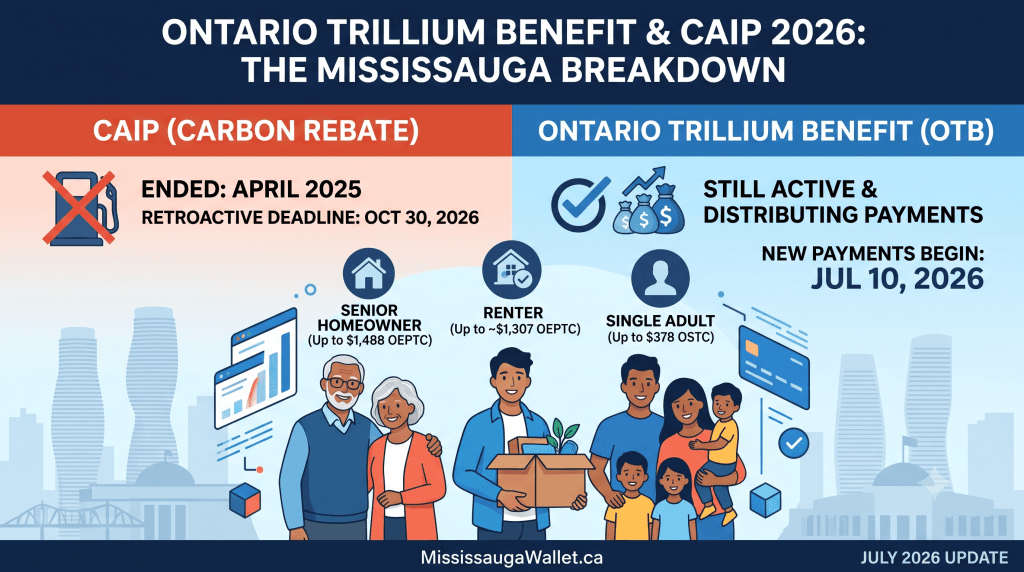
If you're searching "CAIP 2026" or "carbon rebate Mississauga," the honest answer is the one most sites bury at the bottom: that program is gone. But it's frequently confused with a completely different, still-active provincial credit that most Mississauga renters, homeowners, and seniors qualify for — and that a lot of people leave partly unclaimed. This piece separates the two clearly, breaks down what the still-active benefit is worth this year, and walks through what it actually looks like for three different Mississauga households.
1. What actually happened to CAIP
The Climate Action Incentive Payment — later renamed the Canada Carbon Rebate — was a quarterly, tax-free deposit meant to offset the federal fuel charge in provinces, including Ontario, that didn't run their own carbon pricing system. The federal government zeroed out the fuel charge on April 1, 2025, and the final regular payment went out that same month. Nothing federal has replaced it, and nothing is scheduled for the rest of 2026.
2. What the Ontario Trillium Benefit actually is
The OTB has nothing to do with carbon pricing. It's the province's way of bundling three separate tax credits into one monthly deposit so the CRA only has to cut one cheque instead of three. You don't apply for it directly — you become eligible by filing your income tax return with Form ON-BEN attached, reporting your rent or property tax paid for the year.
OSTC — a flat-rate credit per eligible adult/child, offsetting the Ontario portion of HST. Calculated automatically, no separate form.
NOEC — restricted to designated Northern Ontario districts. Mississauga residents don't qualify.
What the 2026–27 benefit year is actually worth
The payment landing July 10, 2026 is the first one calculated from your 2025 return rather than your 2024 one — and the maximums were indexed up slightly.
| Credit | 2025–26 (2024 return) | 2026–27 (2025 return) |
|---|---|---|
| OSTC — per eligible adult/child | $371 | $378 |
| OEPTC — non-senior | $1,283 | ~$1,307 |
| OEPTC — senior (65+) | $1,461 | ~$1,488 |
Both credits phase out as adjusted family net income rises, generally starting somewhere in the $25,000–$35,000 range depending on the credit and household type — check the CRA's Child and Family Benefits Calculator for your exact number.
3. What this actually looks like for three Mississauga households
Strong candidate for close to the full OEPTC plus a partial OSTC — this is the profile the credit is built around. Most likely to be under-claiming if Form ON-BEN wasn't filed with rent reported.
Often near the maximum senior OEPTC, and may separately qualify for the Ontario Senior Homeowners' Property Tax Grant — up to $500/yr, same form, separate payment schedule.
OEPTC and OSTC typically phase out substantially or entirely at this income level — still worth filing the form in case income drops the following year.
Because your OEPTC amount is driven directly by the rent or property tax figure you already track for budgeting, you likely already have the two numbers you need — the same inputs behind our Property Tax Estimator and Rent Affordability Matcher.
4. What to actually do, depending on who you are
- Renters: file Form ON-BEN every year with your landlord's name and total rent paid — even if nothing changed since last year, since the OEPTC doesn't renew itself.
- Condo owners: ask your condo corporation for the property tax portion of your fees — most issue an annual statement — and use that figure on Form ON-BEN.
- Seniors: check the Ontario Senior Homeowners' Property Tax Grant on the same form — it's easy to miss since it arrives on a separate schedule from the regular OTB deposit.
- Anyone who missed CAIP for 2021–2024: file those returns by October 30, 2026. This is the last chance for retroactive amounts — after that date, they're gone permanently.
- Everyone: don't assume your OTB amount is the same as last year's — the 2026–27 benefit year is the first one calculated off your 2025 return, so a change in income, rent, or address already changed your number.